
Article
Why soothing your nervous system might be your most important leadership tool
Discover why leaders must regulate their own stress before guiding teams through change. Learn the science behind stress, burnout, and emotional regulation, and…
 Written by
Clare E Kenny
Written by
Clare E Kenny
- Published
- Reading time
- 6 min read
When things feel uncertain or pressured at work, there’s often a rush to focus on the team - to communicate more, provide reassurance and manage the external chaos.
But the truth is, the most powerful thing any leader can do in times of stress is to regulate themselves first.
Start with yourself
If you're in survival mode, it's much harder to lead others effectively. The way you show up - your tone, your energy, your presence - ripples through the people around you. And when you're stressed or overwhelmed, that ripple can do more harm than good.
This is why learning to regulate your own nervous system is one of the most essential leadership tools there is.
What happens in your brain and body during stress?
Stress isn’t just a mindset. It’s a physiological process that plays out in the body - and it can affect everything from your decision-making to your ability to connect with others.
When your brain perceives a threat, your amygdala (the emotional alarm system) triggers a fight-or-flight response. This releases adrenaline and cortisol, increases your heart rate, and prepares you to react fast. That’s great if you're escaping danger - not so great if you're trying to lead a team meeting or support a colleague!
In times of uncertainty or stress, your amygdala is likely working overtime leaving your nervous system stuck in flight or flight.
Leadership in survival mode is leadership at risk
When you’re stuck in fight or flight, a few things tend to happen...
You make reactive decisions instead of thoughtful ones.
You communicate with less clarity or compassion.
You’re more likely to micromanage or emotionally withdraw.
You leak stress - and your team (and family!) absorbs it.
We see this play out in moments of overwhelm, change or crisis. The very moments when leadership is most needed...are the moments when many leaders are least resourced to provide it.
This is why self-regulation isn't a luxury. It’s a leadership skill.
Burnout and stress physically change the brain
It’s not just in the moment. Chronic stress and burnout actually change the brain’s structure.
The amygdala enlarges, making us more emotionally reactive.
The prefrontal cortex thins, affecting our focus, decision-making and self-regulation.
The connection between emotional and rational parts of the brain weakens - making it harder to calm down or think clearly.
This is why even high-performing leaders can suddenly feel overwhelmed, snappy, or disconnected. Their brain is under siege. And unless we process that stress - not just mentally but physically - it sticks around.
You can’t lead (or live) well if you’re always stuck in the red zone
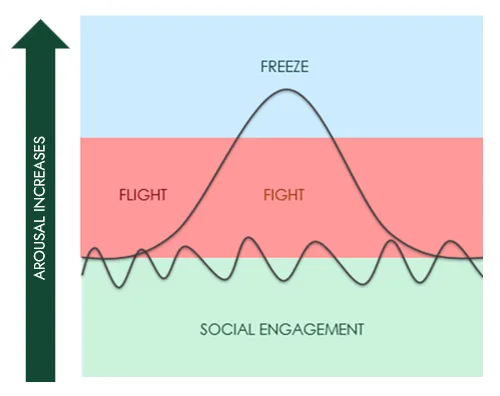
Drawing on polyvagal theory, we can think of the nervous system in three zones...
Green zone - calm, curious, connected. Where we lead best.
Red zone - fight or flight. Fast, reactive, emotional.
Blue zone - freeze. Shutdown, withdrawal, numbness.
We all move between these zones. That’s normal. But the goal is to notice when you're in the red - and support yourself back into the green. That’s where grounded leadership lives.
What does this mean for leadership?
Let’s get practical. If you want to lead your team through stress, start by soothing your own system. Here’s how.
Step 1: Use preventative self-regulation tools daily
You’ve likely heard these before - but the key is not just knowing them, but practising them consistently, especially in calm moments so you’re more resilient in crisis.
Move your body - Physical activity helps discharge stress hormones.
Prioritise rest and sleep - Not a ‘nice to have’, but essential for brain function and regulation.
Eat real food - Fuels energy and stabilises mood.
Seek connection - Talk, share, spend time with people who ground you.
Spend time outside - Natural light and air reset your nervous system.
Create space for stillness - Even 5 quiet minutes without a screen makes a difference.
Step 2: Learn to cope in the moment
When you feel triggered, your body needs 6 -10 seconds to move through the initial amygdala hijack and allow your logical brain to come back online. In those moments...
Breathe - Inhale for 4, hold for 4, exhale for 6. Slows your system.
Pause - Say, “Let’s take a break and come back to this.” Create a reset.
Ground yourself - Feel your feet, stretch, shake your hands. Get into your body.
Name it - Saying “I’m feeling triggered right now” creates space and awareness.
Step 3: Process stress after the moment has passed
If you never release your stress, it builds up like steam in a pressure cooker. To complete the stress cycle, try..
Movement (the best way to process and move out of flight of flight is to fight or flee - so get your body moving!)
Laughter or creativity
Journaling or reflection
Talking to someone you trust
Crying (yes, really - crying is the physical release of emotions and stress from your body)
This isn’t about becoming zen or emotionless. It’s about clearing the emotional residue so you don’t carry it forward into next week, next month and beyond. Every trigger, every emotion and bit of stress needs to be processed and moved out of your body, otherwise it gets stuck and builds up over time.
Why this matters: the ripple effect of regulated leadership
When leaders regulate themselves first, everything changes. You...
Model healthy, sustainable behaviours.
Create psychological safety for your team.
Give permission for others to slow down and care for themselves.
Build trust through calm, consistent leadership - even during uncertainty.
As Simon Sinek reminds us, leadership is an infinite game. It's not about getting through today. It's about showing up again tomorrow, and the day after that, with integrity, presence, and care.
One last thing...
You don’t have to be perfect. You just have to be present. And that starts with calming your own system.
Because in a world where so many people are stuck in stress, the most powerful thing a leader can do is be a calm nervous system and influence in the room.
Want more practical insights on leadership, wellbeing and culture? Subscribe to my newsletter for real stories, fresh thinking, and tools that help your people thrive. clareekenny.com/subscribe
Ideas and resources
More from me
Twice a month
Newsletter
Short, practical thinking on survival mode, psychological safety and burnout at work.
Subscribe to the newsletterPDF guides and tools
Free resources
Guides and tools for psychological safety, burnout and neuroinclusion.
Explore free resources