Article
Building psychologically safe teams in extremely high-pressure roles
Build psychological safety before the crisis. Practical tools for high-pressure teams to speak up early, reduce risk, and perform at their best.
 Written by
Clare E Kenny
Written by
Clare E Kenny
- Published
- Reading time
- 9 min read
In high-pressure environments, performance is not just about technical skill. Psychological safety enables people to speak up early, challenge assumptions, and learn fast.
Build it before the crisis with trust, curiosity, and small, consistent habits that help people perform at their best when it matters most.
Why psychological safety is the decisive edge under pressure
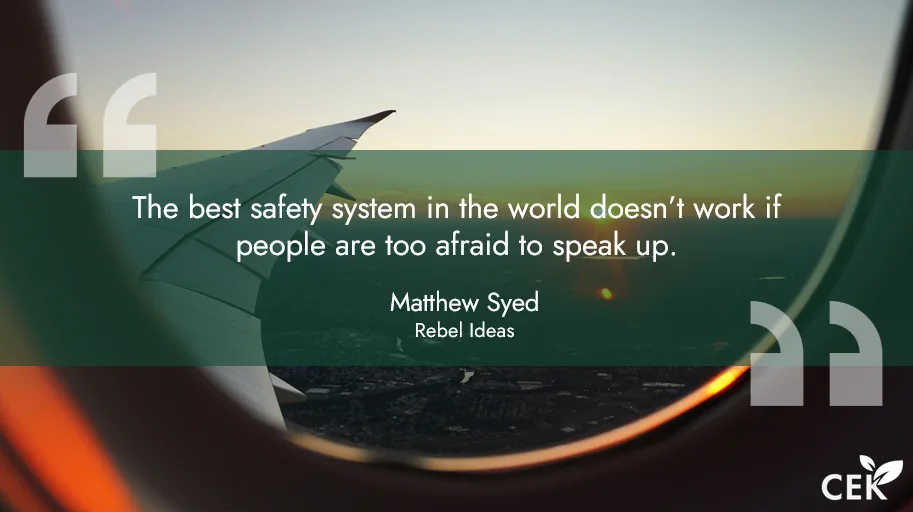
In high-strength, high-pressure environments, even the best systems can fail if people do not feel safe to speak up. Performance under pressure is never just about technical skill or process; it depends on how people behave with each other when the stakes are high.
Building psychological safety is what enables teams to raise concerns early, challenge assumptions, and recover quickly when things go wrong.
A story from the skies...why psychological safety saves lives
In December 1972, Eastern Air Lines Flight 401 was preparing to land in Miami when a landing gear warning light came on. The captain became completely absorbed in trying to work out what the issue was - whether the light itself was faulty or whether the landing gear had failed to deploy.
As the captain focused on the warning light, the first officer and flight engineer noticed that the aircraft’s altitude was getting dangerously low. Both were aware of the risk, but neither felt able to directly challenge the captain or insist that his attention return to the instruments.
By the time the problem was recognised, it was too late. The aircraft had descended into the Florida Everglades. Of the 176 people on board, 101 were killed.
When investigators recreated the event in simulators, they found the same pattern repeated again and again...
first officers would rather die than contradict their superior.
That tragedy became a turning point for the aviation industry. It led to the introduction of 'Crew Resource Management' - an approach designed to flatten hierarchy, strengthen communication, and make sure every voice in the cockpit could be heard.
The results were remarkable. Safety improved dramatically, and the aviation industry became a model for how trust, communication and psychological safety can save lives.
What psychological safety actually is
Psychological safety is the shared belief that it is safe to speak up, ask for help, and challenge the status quo. Harvard’s Amy Edmondson discovered this concept while studying hospital teams and rates of medical error. She expected the most cohesive teams to make fewer mistakes but found the opposite - they reported MORE!
The reason was not poorer performance but greater openness. Those teams felt safe to admit errors early, learn from them, and prevent them from escalating.
Later, Google’s 'Project Aristotle' studied 180 teams over 2 years and found psychological safety was the strongest driver of performance. When people feel safe, they engage more, innovate more, raise risks sooner, and burn out less.
In other words, the most successful teams are not the ones that never make mistakes - they are the ones that talk about them early and learn quickly.

Pressure changes behaviour
Under pressure, none of us is at our best. Our nervous system moves into survival mode - fight, flight or freeze. When that happens, our focus narrows, our patience shortens, and our ability to think creatively or empathically declines.
It’s not a character flaw; it’s biology. The brain’s threat response diverts energy away from the prefrontal cortex (the part responsible for reasoning, problem-solving and empathy) and into areas designed for rapid reaction. The result is that we become more rigid, defensive and less open to feedback.
In high-pressure environments, that shift can be costly. Research shows that a single rude comment from an authority figure can have a measurable impact on team performance. In one study of neonatal intensive care surgical teams...
exposure to mild rudeness led to a 50% drop in diagnostic and procedural performance.
(Riskin et al., Proceedings of the National Academy of Sciences, 2017)
Small moments of tone, language, and presence don’t just affect morale - they directly influence how well others can think, collaborate, and perform under stress.
As a leader your nervous system sets the temperature of the room. If you are calm, others regulate around you. If you are tense, they absorb that too. That’s why psychological safety cannot be built in the middle of a crisis. It’s built long before - in the micro-behaviours you model when things are calm: how you listen, how you respond to challenge, how you recover from mistakes, and how you make it safe for others to do the same.
Trust is built in small moments
Think of trust like a jar of marbles. Every small act of reliability, respect and integrity adds a marble. Break trust, and marbles come out. Over time, it is these everyday actions (not grand gestures) that determine whether people feel safe to speak up.
Brené Brown’s BRAVING framework is a useful guide for building trust within teams...
Boundaries. I can care for me and for you at the same time. We are clear on what is okay and what is not.
Reliability. I do what I say I will do.
Accountability. I own my mistakes and invite you to own yours.
Vault. I keep confidences.
Integrity. I act in line with my values, even when it’s hard.
Non-judgement. It’s safe to ask for help or admit a mistake.
Generosity. I assume good intent and check context before taking offence.
Practical tools you can use tomorrow
1) Lead with curiosity and invite challenge. Ask, “What am I missing?” or “What could get in the way?” and really listen to the answers.
2) Listen for the silence. Not everyone thinks out loud. Offer alternative ways to contribute - written reflections, anonymous inputs, or follow-up messages.
3) Anchor feedback to shared goals. “We want the same outcome. How do we get there together?” Remove blame. Focus on learning.
4) Normalise learning from mistakes. Share your own. “If I could redo this week, here’s what I’d change.” Leaders go first.
5) Use micro-tools in the heat of the moment. Agree a short pause phrase or safe word to stop and reset when stress spikes. A simple “I’m sorry” can de-escalate tension quickly.
6) Pre-brief and debrief as a habit. Before: “What are we missing? Any risks?” After: “What went well? What can we do differently next time?”
7) Clarify roles and hierarchy without fear. Clarity matters under pressure. Decide in advance how challenge works: “In the moment, X leads. If you see risk, use the challenge phrase.”
8) Make boundaries a proactive conversation. When someone new joins or tension builds, ask, “How do you get the best out of me?” and “What do you need from me?” Use BRAVING as your guide.
Your leadership ripple effect
People mirror you. Your tone, pace and energy set the emotional temperature of the room. When pressure rises, teams subconsciously look to leaders for cues on how to respond. A calm presence signals safety. A rushed or tense one signals threat.
Before speaking or making a decision in a high-pressure moment, take a pause and ask yourself, “What state do I want to create?” Sometimes that might mean slowing down to steady the group; other times, it’s about bringing energy or clarity when uncertainty creeps in.
Calm is contagious. So is panic. Leaders who can regulate their own nervous system help others stay grounded enough to think clearly, collaborate, and make sound decisions.
And when you do slip (because you will and that's ok!) own it. “I was short with you earlier; that wasn’t fair.”
Quick, genuine repair rebuilds trust faster than perfection ever could.
Those small moments of honesty save time, reduce stress, and strengthen relationships across the team.
A quick self-check for psychological safety
Psychological safety isn’t a fixed state; it ebbs and flows with your leadership habits, the team’s pressure, and the surrounding culture. A quick self-audit can help you stay aware of where things stand...
How often do people give me growth feedback or raise risks early?
If feedback only flows one way, or if risks surface late, people may be protecting themselves rather than the work.
Who isn’t speaking - and how could I invite their input differently?
Notice patterns in meetings or discussions. Is the same group contributing most of the time? Try changing the format, inviting written input, or asking quieter voices first.
Where am I adding marbles to the trust jar this week - and where might I be taking them out?
Reflect on recent interactions. Did I follow through on what I promised? Did I respond with curiosity or defensiveness when challenged? Every action adds up.
These small reflections, repeated regularly, keep psychological safety visible - and remind you that trust and voice are living, breathing parts of leadership.
One small nudge
Pick one or two small changes and commit to them...
Ask one curiosity question per meeting.
Run a three-minute pre-brief.
Share one learning from a mistake.
Agree a team challenge phrase.
Have a BRAVING conversation with a colleague.
Small, consistent actions shift the culture. Safety improves. Performance follows.
Frequently Asked Questions
What is psychological safety in high-pressure environments?
It’s the shared belief that people can speak up, admit mistakes, and challenge assumptions without fear of blame or punishment, even when the stakes are high. It’s what allows teams in sectors like aviation, healthcare and emergency response to perform reliably under stress.
How does psychological safety improve performance?
Teams with high psychological safety communicate earlier, solve problems faster and make fewer preventable errors. People learn more quickly from mistakes and feel motivated to share ideas and raise risks.
Can you build psychological safety in hierarchical teams?
Yes - hierarchy can support clarity and decision-making, but it becomes risky when it’s reinforced by fear. Strong leaders make it clear that challenge is welcome, especially when safety or performance is at stake.
What are some quick ways to build psychological safety?
Start small: ask curiosity questions, thank people for raising issues, model learning from mistakes, and check in with quieter team members. Consistency matters more than grand gestures.
If this resonated, there’s plenty more to explore. On my free resources page - you’ll find podcasts, short videos and downloadable guides designed to help you and your people thrive, at work and beyond.
And if you’d like regular wellbeing, leadership and culture insights straight to your inbox, you can subscribe to my newsletter here.

Ideas and resources
More from me
Twice a month
Newsletter
Short, practical thinking on survival mode, psychological safety and burnout at work.
Subscribe to the newsletterPDF guides and tools
Free resources
Guides and tools for psychological safety, burnout and neuroinclusion.
Explore free resources