
Article
Managing stress and preventing burnout: Practical tools you can use every day
Discover practical stress management techniques and tools to prevent burnout. Learn how to soothe your nervous system and reduce daily stress triggers.
 Written by
Clare E Kenny
Written by
Clare E Kenny
- Published
- Reading time
- 8 min read
Life is stressful!! Ain't it just? Between deadlines, global uncertainty, constant notifications, and the inevitable curveballs that come our way, it’s no surprise that so many of us feel overwhelmed.
Stress in itself isn’t bad, in fact, our stress response is designed to keep us alive. The problem is when we get stuck there for too long.
In this post, I’ll share the science behind what happens to our bodies when we feel stressed, and practical stress management techniques you can use to calm your nervous system, reduce triggers, and prevent burnout.
Understanding stress: So what’s really happening in your body?
Our brains aren’t designed to keep us happy (sorry!) - they are designed to keep us alive.
The amygdala in our brain acts like a lighthouse scanning for threats. When it spots one, it activates our fight-or-flight response: adrenaline and cortisol flood the body, heart rate and blood pressure rise, and we’re ready to act.
The problem is our amygdala hasn't really evolved that much since we were cave men and cave women and it struggles to tell the difference between a life or death threat (like a sabre tooth tiger) and a stressful email.
No wonder so many of us spend much of our day in fight or flight mode!
Stress is useful for short periods of time, but if we stay in fight or flight for too long, the impact is huge: anxiety, depression, hypertension, headaches, skin flare-ups, digestive issues, even burnout - when the body eventually starts to shuts down altogether to protect itself.
The key to effective stress management is two pronged...
Soothe your nervous system so you can return to balance.
Reduce the triggers that keep activating you in the first place.
Stress management techniques to soothe your nervous system
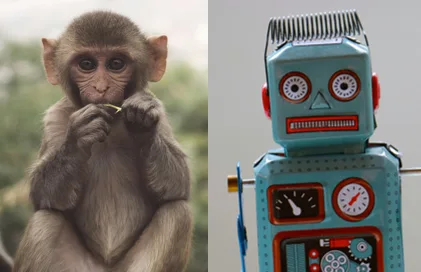
Think of your brain in two parts: the “robot” (logic, decision-making) and the “monkey” (your nervous system). And they don't speak the same language!
When you’re stressed, the monkey takes charge. Logic won’t calm it down, the monkey doesn't understand the robot. You can logically tell yourself to stop worrying or that it's not a big deal but to really calm your nervous system you need to speak directly to the monkey - in the right language!
Here are some practical tools to reduce stress quickly...
Movement
Stress primes your body to run or fight, so moving is the quickest way to release that energy.
Go for a brisk 10–15 minute walk outside.
Put on a favourite song and dance around.
Try “shaking” your body the way a dog does after being startled - arms, legs, shoulders, head.
Breathing exercises
Breathing slowly and deeply tells your body - “You’re safe now.”
Try 4 - 6 breathing: inhale through your nose for 4 counts, exhale through your mouth for 6 counts.
Place a hand on your belly and make sure it rises as you inhale.
Repeat for 2 - 3 minutes when you feel stressed.
Vocal vibrations
Your vagus nerve runs through your throat and is a direct line to calming your nervous system.
Hum your favourite tune, chant “om,” or sing loudly in the car.
Even a few minutes of humming can shift your body back into rest-and-digest mode.
Cold water therapy
Cold activates the “dive reflex,” which slows your heart rate and brings your system back into balance.
Splash your face with cold water.
Run your wrists under a cold tap for 30–60 seconds.
If you’re brave, finish your shower with 30 seconds of cold water!
Grounding through your senses
Grounding takes you out of your head and back into the present moment.
Use the 5, 4, 3, 2, 1 method: notice 5 things you can see, 4 you can hear, 3 you can feel, 2 you can smell, 1 you can taste.
This is particularly helpful when thoughts are racing.
Allowing your feelings (“Flooding”)
Instead of pushing feelings away, let them rise and fall like waves.
Sit somewhere safe and comfortable.
Notice the sensations in your body - tight chest, racing heart, butterflies.
Say to yourself: “This is uncomfortable, but it will pass.”
Allow the feeling to crest and then subside (this helps tell your amygdala and nervous system that it's been heard and it can stop sending you warning signals).
Reducing stress triggers: Long-term burnout prevention
Now we can’t avoid all stress, but we can stop adding unnecessary fuel to the fire! So much of our stress is self inflicted.
Here are three evidence-based tools to help reduce triggers and prevent burnout...
Circles of control

A simple but powerful tool for stress management is the circles of control. It helps you focus your energy where it will actually make a difference, rather than exhausting yourself worrying about things you can’t change.
Draw three circles...
Inner circle (Control): the things directly within your control - your actions, words, choices, daily habits.
Middle circle (Influence): the areas you can’t directly control, but where your behaviour can make a difference - your relationships, your health, your career progression, your team culture.
Outer circle (Concern): things you have no control over - the economy, other people’s choices, world events, the weather.
So often, stress builds when we spend most of our time in the outer circle, worrying about things we can’t change.
Here’s how to apply it in practice...
Notice when your thoughts are circling around an “outer circle” issue (for example: “What if there’s another restructure at work?”).
Pause and reframe: ask yourself, What can I do in my inner or middle circle instead? (for example: “I can keep my CV updated, focus on doing great work, and have proactive conversations with my manager”).
Shift your energy: bring your focus back to the things you can influence, rather than draining yourself with the things you can’t.
This isn’t about ignoring big issues or pretending not to care - it’s about reclaiming your energy for the areas where you can genuinely have an impact. Over time, that shift reduces stress, builds resilience, and protects against burnout.
Boundaries

Resentment is often a sign that a boundary has been crossed.
To set healthier ones...
Notice when you feel drained, frustrated, or annoyed - these are early warning signals.
Clarify: What do I need to protect here? (my time, energy, wellbeing, values).
Communicate your boundary clearly and kindly, ideally before it gets crossed.
Brené Brown sums it up with the phrase: “choose discomfort over resentment.”
What does that mean? Often, we avoid setting boundaries because it feels awkward in the moment. Saying no to a request, pushing back on a deadline, or telling someone what you need can feel uncomfortable - you worry about disappointing others, or about being seen as “difficult.”
But if you avoid that short moment of discomfort, the trade-off is much worse: weeks or months of simmering resentment. You say yes when you really wanted to say no, and end up drained, frustrated, or even burnt out.
Choosing discomfort is about tolerating that brief, awkward moment - the honest conversation, the polite but firm “no” - because it protects you from the much heavier weight of resentment down the line.
In practice, this might look like...
Saying - “I can’t take that on right now - here’s what I can realistically deliver.”
Asking - “What’s the priority here?” instead of silently absorbing more work.
Explaining - “I do my best work when I have time to recharge, so I won’t be checking emails after 6pm.”
Boundaries are not about being selfish. They’re about creating the conditions where you can bring your best self to your work and relationships - which benefits everyone.
Reframing Your thinking
Stressful thoughts often spiral. Reframing helps you shift perspective. Try...
Cross-examine: Is this thought based on facts or assumptions?
Zoom out: Will this matter in a week, month, or year?
Best friend test: What advice would I give my best friend? Can I give myself that level of compassion?
Gratitude flip: If you’re stuck on a negative thought, ask - "What’s one thing I can appreciate right now?"
Why stress management matters for burnout prevention
Stress itself is not the enemy - it can even sharpen performance in short bursts. The danger lies in staying activated for too long.
By soothing your nervous system and reducing triggers, you allow your body to recover, protecting both your wellbeing and your long-term performance.
It’s not about overhauling your life overnight. It’s about building a small toolkit of stress management techniques you can turn to every day. Incremental shifts add up - and over time, they can make the difference between thriving and burning out.
What next?
Choose one tool from each section above - one way to soothe your nervous system and one way to reduce triggers.
Try them this week and notice the difference and let me know how you get on!
If you'd like wellbeing, leadership and culture tips straight to your inbox you can subscribe to my newsletter here - https://www.clareekenny.com/subscribe
Ideas and resources
More from me
Twice a month
Newsletter
Short, practical thinking on survival mode, psychological safety and burnout at work.
Subscribe to the newsletterPDF guides and tools
Free resources
Guides and tools for psychological safety, burnout and neuroinclusion.
Explore free resources